Community - Lacrosse 101

Lacrosse 101

OVERVIEW

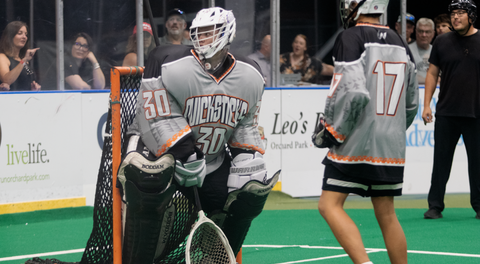
Box lacrosse, previously referred to as indoor lacrosse outside of Canada, is played inside the confines of an ice hockey rink, with glass and dasher boards fully intact. The playing surface consists of a green dieter turf carpet that is laid down over the hockey ice. On average, the two teams competing combine to score a total of 25 goals during a game.

During standard play, each team has five (5) runners and one (1) goaltender on the floor during the game. Each team dresses 20 players (18 runners and 2 goaltenders) per game, and the players rotate on and off the floor in shifts (cycling forward, transition, defence players as needed), similar to ice hockey. The game consists of four (4) quarters, each fifteen (15) minutes in length. At the end of regulation time, if a game is tied a sudden-death overtime 'period' of the (10) minutes is played. There are no tie games in major junior lacrosse.

CLL RULES

Rosters: 30-man roster, each team dresses 20 players for games, consisting of 18 runners and 2 goalies. A team shall be composed of six (6) players on the floor, 5 runners and 1 goalie.

Time Format: Four 15-minute quarters; 2 minutes between quarters; 12 minute halftime.

Timeouts: Each team may take one (1) 45-second timeout per half. A televised game has two timeouts per quarter.

Sudden Death Overtime: Games ending regulation play with a tie score are decided by a sudden death overtime period. Play continues until a goal is scored. More than one overtime period is played if necessary with a break between the first and second overtimes if needed.

8-Second Violation: Occurs when a team fails to advance the ball past mid-floor from their own defensive end within 8 seconds after taking possession.

Face-Offs: To determine possessions at the start of each quarter and after every goal, two players face their sticks at mid-floor with a referee placing the ball between the heads of the sticks.

Shot Clock: A 30-second clock begins (counting down) when a team assumes possession of the ball. The offensive team must put a shot on goal during that time or they will lose possession. If they do shoot on goal (without scoring) and recover possession of the ball (via rebound/loose ball recovery), the clock is reset for a new 30 seconds. 

Official Rulebook (link)

TERMS Of The Game

Body Check: Used to slow an opponent who has the ball; must be above the waist and below the neck.

Breakaway: One-on-one (shooter on goalie) scoring opportunity.

Cradle: Method used to keep the ball inside the pocket of the stick by rocking it back and forth.

Crease: Only the goalie can stand in this nine-foot radius with the ball. Shooters or their teammates can not stand on (or inside) the line or their goals won't count. Any violation of this rule will disallow the goal.

Crosscheck: A defensive strategy using the shaft of the stick to push on an opponent to force a missed or bad shot.

Hidden Ball Play: A player without the ball cradles his stick, drawing the attention of the defence, while a teammate who has the ball passes or shoots on net.

Hat Trick: When a player scores three (3) goals.

Sock Trick: When a player scores six (6) goals.

Loose Ball: Occurs when there is no possession and the ball is bouncing, rolling, or rebounding off the boards or goaltender.

Major Penalty: Five minutes in the penalty box for infractions such as high sticking, boarding, face masking, fighting and spearing.

Man Down: When a team has one less player on the floor than their opponent.

Minor Penalty: Two minute penalty for infractions such as delay of game, elbowing, holding, illegal crosschecking, slashing, and tripping, for example.

Offensive Pick: The legal interference by an offensive player from a set position on a defensive player who is trying to defend the ball carrier.

Outlet Pass: The first pass from the goaltender or defender that begins the transition from defence to offence.

Penalty Box: Where a player goes to sit while serving a two and/or five minute penalty.

Power Play: When a team has an extra man advantage because the other team has at least one player in the penalty box

Screen Shot: When the goaltender can't see a shot because someone is in the way.

Shorthanded: When a team has one or more players in the penalty box and the opponent is at full-strength, or has more players on the floor.

Loss of Possession: Illegal screens, 30 second shot clock violation, 8 second half court violation, loose ball push, and illegal procedure during faceoffs are among the acts that can cause a team to lose possession of the ball.

PLAY OF THE GAME

Minor Penalties: On two minute personal fouls, the penalized player is released from the penalty box if a goal is scored before the expiration of the two minutes.

Major Penalties: On five minute major personal fouls, the penalized player stays in the box for the duration of the penalty, though the offending team returns to full strength if two goals are scored against them during the five minutes. When a second major penalty is imposed on the same player in a game, an automatic game misconduct penalty shall be imposed.

Use of Penalty Shot: Since a team cannot be more than two men down at a time, if a third penalty is called, the official will award a penalty shot to the non-offending team.

Ejection from Game: Players can be ejected from a game for several reasons including being the third man participating in a fight or accumulating two major penalties in one game.

Slow Whistle (Delayed Penalty): If a defending player commits a minor or major penalty against an opponent in possession of the ball, the 30-second shot clock expires, or a goal is scored or possession is gained by the non-offending team.

Coincidental Penalties: When each team is given the same amount of penalty time arising out of the same incident, the offending players shall not be released until the expiration of the penalty. Teams do not lose floor strength, and the ball is awarded to the team who was in possession prior to the fouls.

Floor and Goals: Box lacrosse is played on a hockey rink on a bare cement floor or covered by an artificial turf or wood playing surface, which is usually referred to as the floor (as opposed to and never as field). There must be boards around the sides of a minimum height of 3' high. Dimensions are 200' x 85' but may be altered.

Goals: The Goals, or Nets, are 4' (high) x 4'9" (wide). The circle around the goal known as the crease is 9'3" in diameter. An offensive player is not allowed to step into the crease area.

LACROSSE IN CANADA

Modern lacrosse in Canada has been a popular sport since the mid 1800s. Only field lacrosse was played until the 1930s, when box lacrosse was invented. In 1994 Parliament passed the National Sports of Canada Act which declared lacrosse to be "Canada's National Summer Sport", with ice hockey as the National Winter Sport.[1]

History

Lacrosse was played by First Nations peoples before the arrival of European colonists. The first documented description of the game was in 1637. The game was called baggataway and tewaarathon, which was played by two teams with 100 to 1,000 men each on a field that stretched from about 500 m (1,600 ft) to 3 km (1.9 mi) long.[1] 

The Anglophone middle class of Montreal adopted the game in the mid 1800s. The first known game between Europeans and First Nations took place in 1843.[2][3][4] 

In 1856, the Montreal lacrosse club was established; by the mid-1860s there were active teams in eastern Ontario. The National Lacrosse Association was formed in 1875; in 1880 the league became the National Amateur Lacrosse Association.[5] By the 1880s the organized sport was found nationwide, and had become a popular spectator sport. To deal with the violence, middle class promoters spoke in Social Gospel terms about the ideal of "muscular Christianity." As working class players and spectators became more prominent, the rhetoric focused on winning at all costs.[6] 

The 1860s the Montreal Shamrocks introduced a new level of aggressiveness; it was Irish, Catholic, and fought to win.[7] During the 1870s and 1880s the Shamrocks had bloody confrontations with the middle-class Protestant Montreal and Toronto Lacrosse Clubs. Field lacrosse was spread across Canada by Anglophone migrants from Ontario and Quebec. In February 1887, the Toronto Lacrosse Club began using hockey as a form of exercise during the winter months.[8] By the early 1890s it was the most popular summer game in Canada; the 1900s were the golden years, as two professional leagues were set up.[9] Escalating violence led to the collapse of the professional leagues in 1914, and the game's base of support shrank to Montreal, Victoria, Vancouver, New Westminster, and a few small-towns. Its failure to establish a solid base derived from a thin organizational infrastructure; for example, it was not played by schools or churches.[10] The Canadian Lacrosse Association, founded in 1925, is the governing body of lacrosse in Canada. It presently conducts national junior and senior championship tournaments for men and women in both field and box lacrosse. 

In 1931, big city hockey promoters introduced "box lacrosse" to turn winter hockey fans into a year-round audience. Box lacrosse was played in a smaller indoor arena space, and competitions could also be held in baseball stadiums, and again, the play was violent. Not enough cities could support teams, however, and the hard times of the Great Depression in the 1930s reduced the number of fans. Entrepreneurs, while failing to make a major commercial success, transformed Canadian amateur lacrosse, making it quite different from field lacrosse as played in the United States, Britain, and Australia. In 1987 the National Lacrosse League began; it has clubs in twelve cities in the United States and Canada.[11]

21st Century

In 2003, Canada participated in the inaugural World Indoor Lacrosse Championship. 

The CLA along with 5 other National sporting association had their charitable status revoked in June 2010 as part of a Revenue Canada crackdown on Parklane Financial's tax shelter scheme, in which charitable organizations issued receipts far in excess of any material donations. The fact that the CLA Board of Directors agreed to participate in such a scheme may in part be due to the fact that the CLA Board of Directors is largely made up of elected lacrosse representatives, with no particular expertise in legal or financial matters of governance. 

At the provincial level, the Ontario Lacrosse Association controls the majority of lacrosse in Ontario. The OLA is governed by a larger Board than the CLA, though also populated largely by members with a strong lacrosse background. OLA lacrosse officials are sanctioned by the OLA, and represented by the Ontario Lacrosse Referees Association (OLRA). Unlike typical referee associations, the OLRA has a governing structure that is open only to Box lacrosse officials who officiate Junior/Senior/Major-series games, though the vast majority of officials do not officiate at that level. The OLRA is an extension of the OLA, and does not represent an independent officiating union. 

The National Lacrosse League is a professional box lacrosse league, with franchises in Canada and the United States. The 2006 World Lacrosse Championship was held in London, Ontario. Canada beat the United States 15-10 in the final to break a 28-year U.S. winning streak. One of the best lacrosse players of all time, Gary Gait was born in Victoria, British Columbia and has won every possible major lacrosse championship. Great achievements in Canadian Lacrosse are recognized by the Canadian Lacrosse Hall of Fame. 

Canada' National Game Debate

In May 1964, former Canadian Amateur Hockey Association president and then current member of parliament Jack Roxburgh did extensive research to find if Canadian parliament had ever declared a national game, and specifically looked into whether lacrosse was officially declared. After going through parliamentary records, he found no law was ever enacted. The Canadian Press reported at the time that the myth of lacrosse as Canada's national game possibly came from a book published in 1869 titled Lacrosse, the National Game of Canada, and that the Canadian Lacrosse Association was founded in 1867.[12][13] His endeavour to declare hockey as Canada's national game coincided with the Great Canadian Flag Debate of 1964.[14] On October 28, 1964, Roxburgh moved to introduce Bill C–132, with respect to declaring hockey as the national game of Canada.[15] 

Canadian Lacrosse Association members responded to the motion by calling it insulting and "out of line", and vowed to fight it.[16] On June 11, 1965, Bob Prittie replied by introducing a separate bill to have lacrosse declared as Canada's national game and stated that, "I think it is fitting at this time when we are considering national flags, national anthems and other national symbols, that this particular matter should be settled now".[14] The choice of Canada's national game was debated in 1965, but neither bill was passed when parliament was dissolved.[17] In 1967, Prime Minister Lester B. Pearson proposed to name national summer and winter games, but nothing was resolved. Finally in April 1994, Bill C–212 was passed to recognize hockey as Canada's official winter game, and lacrosse as its summer game.[14]